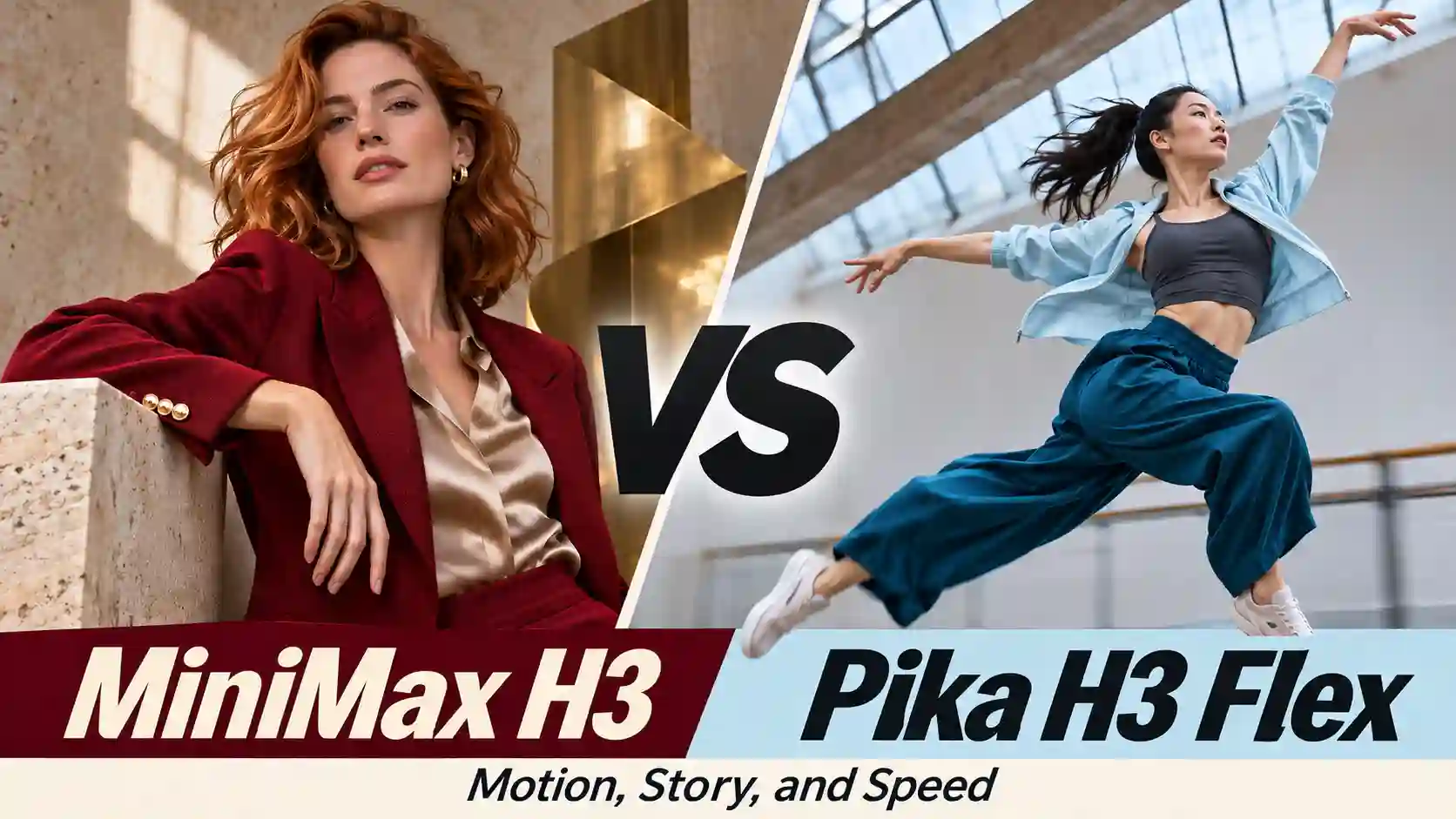
What Is Pika H3 Flex?
Pika H3 Flex is Pika’s post-trained version of MiniMax H3, built for rapid creative iteration. Its main characteristics include:
Fast drafting: A six-step generator for exploring concepts and trying alternatives.
Reference-guided creation: Image, video, and audio inputs help guide appearance, movement, and sound.
Flexible finishing: Pika-hosted upscaling and audio-stem exports give editors more control over final delivery.
We compared MiniMax H3 and Pika H3 Flex across realistic dialogue, animation, multi-reference long takes, and action sequences. This review examines how they handle movement, narrative clarity, and camera expression, with specifications and workflow considerations to help you choose.
TL;DR: MiniMax H3 vs Pika H3 Flex
Both models produced convincing visuals, with strong realism or stylization and consistent characters in the relevant examples.
MiniMax H3 showed more coherent scene interpretation in our comparison, connecting actions and reactions with greater care.
Pika H3 Flex emphasizes fast iteration, making it useful to consider for concept previews and alternative creative directions.
How We Compared Motion, Storytelling, and Detail
Follow the scene through its transitions.
We assessed four qualities:
Consistency: Whether appearance, style, and setting remain recognizable.
Motion: Whether actions connect smoothly and serve a clear purpose.
Narrative clarity: Whether the order of events communicates cause and reaction.
Atmosphere: Whether camera treatment, sound, and environmental detail support the mood.
The observations below are qualitative judgments about these four comparisons.
Four Video Comparisons: Motion, Storytelling, and Atmosphere
The most revealing differences appeared between the major events.
Realistic Character Motion: A Climber Turns to Speak
A woman climbs a rock wall and turns to speak to the camera. Both versions look realistic and preserve her appearance.
What we noticed:
Pika H3 Flex: An abrupt change of climbing hold interrupts the movement. The turn from climbing to speaking also feels sudden.
MiniMax H3: Her movements appear more deliberate and confident, with a smoother transition into speaking.
MiniMax’s version made the physical activity and spoken moment feel like parts of the same performance.
For realistic AI character motion, visual consistency alone does not establish continuity of behavior.
AI Animation Storytelling: The Escaping Bao
A bao escapes while a chef is distracted. The chef notices and tries to catch it, only for the bao to jump into the pot itself.
Both models maintain a convincing stylized look. Pika’s version becomes less persuasive in two details:
Preparation stage: The bao are already shaped, but the chef continues with actions that belong before shaping. The handling does not match the state of the food, making the cooking behavior feel implausible.
Discovery: The chef turns to pursue the bao abruptly, without clearly registering an unexpected event. The chase feels as though the chef already knew what would happen.
MiniMax H3 gives the chef a noticeable pause after spotting the escape. That beat makes the sequence easier to read: notice, react, then pursue.
The pause was the detail that changed our interpretation. It helped communicate surprise and made the character’s next action feel motivated.
Multi-Reference Video: A Continuous Running Shot
The running comparison uses the same female character and setting references. Both models preserve those references and maintain consistency throughout the long take.
Here, the difference is how the scene feels:
MiniMax H3: Camera shake and supporting sound create a stronger sense of immediacy. A leaking-water detail gives the environment another point of interest.
Pika H3 Flex: The fixed camera presents the action clearly but feels less dynamic for this sequence.
We preferred how MiniMax made the setting feel involved in the action. Its reference fidelity was supported by a more immersive interpretation of the scene.
Action and Obstacle Handling: Dogs Running Across the Desert
Two dogs run through desert terrain containing rock obstacles. The overall visual quality is broadly comparable, but their routes create different impressions.
MiniMax H3 keeps the movement fast and fluid. The dogs clear the rocks directly and continue forward with momentum.
Pika H3 Flex adds several steps on the rocks before the dogs continue. Those extra movements look more awkward and stiff, interrupting the urgency of the run.
What stood out to us was the choice of action at the obstacle. MiniMax’s approach better preserved the excitement of this sequence.
Speed vs Scene Refinement: Which Model Fits Your Workflow?
Consider how you will use each generation.
Our preferences from these comparisons point to two practical priorities:
For a scene that needs close refinement, we would favor MiniMax H3. Its more complete interpretation of performance, narrative beats, and atmosphere made the examples feel more resolved.
For early exploration, Flex offers a speed-focused workflow. It is worth considering when you want to compare concepts, preview compositions, or try several creative directions.
Pika reports as little as seven seconds of transformer computation for a 15-second 768p clip. That measures controlled core computation, not the complete wait from submission to download. References, finishing, and service overhead affect turnaround.
The useful question is how quickly a workflow gets you to an output you can use. Our four comparisons favor H3’s scene organization, while Flex’s iteration benefits depend on the task and service.
Creative Direction Tips for More Coherent AI Videos
Give the model a clear relationship between events.
For your own generations, these observations suggest four directions to try:
1.Define the transition. Explain how the subject moves from an active pose into a stable speaking position.
2.State what triggers a reaction. Identify what changes, what the character notices, and what they do next.
3.Give the camera one clear role. Specify an observational view or a more immediate following perspective, along with any limits on environmental additions.
4.Preserve momentum through obstacles. Describe the intended way of passing an obstacle and whether forward movement should continue without hesitation.
These are prompting suggestions drawn from the comparison, rather than verified fixes. For preparing and assigning inputs, see our MiniMax H3 reference-to-video guide.
Create Your Next Scene with MiniMax H3
Begin with one clear creative goal.
Bring your reference image or short brief to MiniMax H3.
Generate a manageable scene, review its most important transition, and refine that decision before adding complexity.
MiniMax H3 vs Pika H3 Flex FAQs
Is Pika H3 Flex Simply a Faster MiniMax H3?
No. Flex adds fine-tuning, six-step distillation, and preference optimization to the H3 foundation. These changes modify the learned weights and sampling process, so the same creative brief can lead to different movement, visual style, or narrative choices.
Does Pika H3 Flex generate native 4K video?
No. Its higher-resolution output uses a hosted finishing stage. When reviewing an upscaled clip, check whether fine details, text, and motion remain stable, alongside the larger pixel dimensions.
Should I use the same prompt when comparing both models?
Yes, a shared creative brief is a useful starting point. Record later model-specific revisions separately so that changes in direction remain distinguishable from differences between models.
Does faster generation mean faster movement on screen?
No. Generation speed describes production time; movement speed describes the action in the video. They are separate factors.
Does a fixed camera mean the model failed?
No. A locked shot can be useful when clarity or a steady composition matters. Camera movement should be judged against the intended experience of the scene.